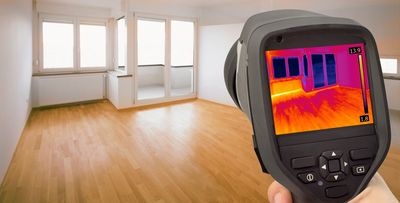
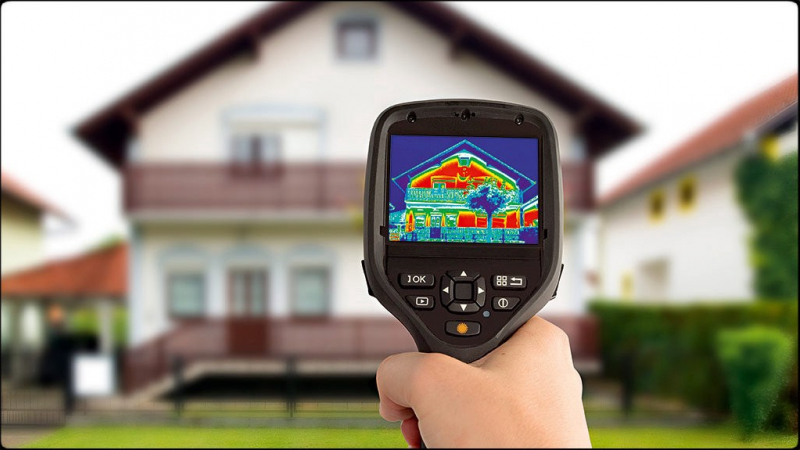
Thermography measures surface temperatures by using infrared video and still cameras. These tools see light that is in the heat spectrum. Images on the video or film record the temperature variations of the building's skin, ranging from white for warm regions to black for cooler areas. The resulting images helps determine whether insulation is needed.
A thermographic inspection is either an interior or exterior survey. Our energy auditor decides which method would give the best results under certain weather conditions. Interior scans are more common, because warm air escaping from a building does not always move through the walls in a straight line. Heat loss detected in one area of the outside wall might originate at some other location on the inside of the wall. Also, it is harder to detect temperature differences on the outside surface of the building during windy weather. Because of this difficulty, interior surveys are generally more accurate because they benefit from reduced air movement.
Thermographic scans are also commonly used with a blower door test running. The blower door helps exaggerate air leaking through defects in the building shell. Such air leaks appear as black streaks in the infrared camera's viewfinder.
To prepare for an interior thermal scan, the homeowner should take steps to ensure an accurate result. This may include moving furniture away from exterior walls and removing drapes. The most accurate thermographic images usually occur when there is a large temperature difference (at least 20°F [14°C]) between inside and outside air temperatures. In northern states, thermographic scans are generally done in the winter. In southern states, however, scans are usually conducted during warm weather with the air conditioner on.
Some times of the year, because of a phenomenon known as “thermal loading,” it might be necessary for the homeowner–depending on local conditions--to create and maintain a specific inside/outside temperature difference for a period of up to four hours before the test will be performed.